

Samoosas and frozen savouries
Samoosas & Savouries
5 Min Read
Handmade vs Machine-Made Samoosas
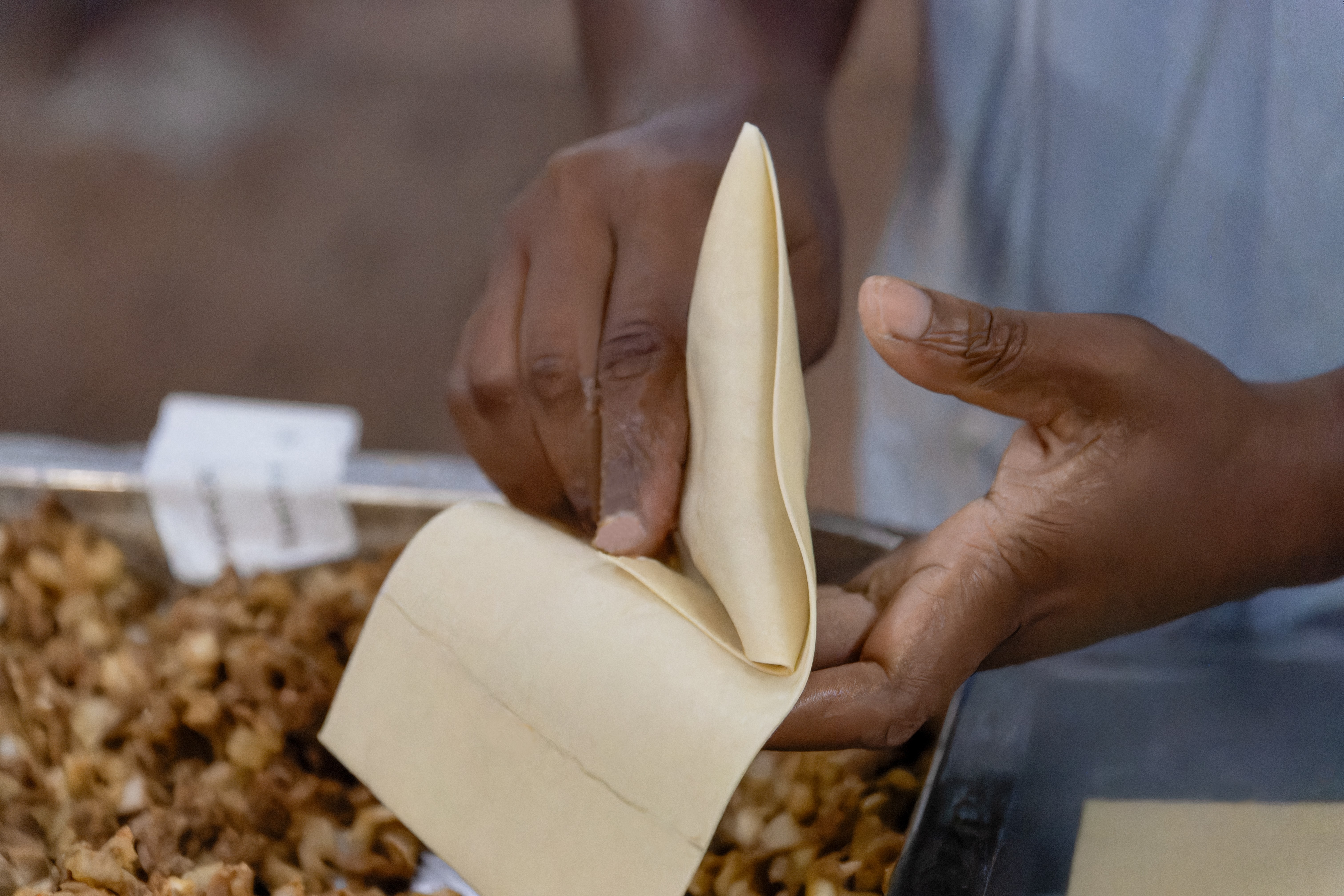
Compare handmade and machine-made samoosas, from folded pastry and crispness to consistency, hot-holding and cost per cooked portion in foodservice.
Samoosas may be handmade using a traditional folding method or formed using automated equipment. While both methods can produce a triangular filled pastry, the construction of the product, and particularly the pastry, can be noticeably different.
A handmade samoosa is created by placing the filling onto a strip of pastry and folding it repeatedly into a triangle. This traditional method creates overlapping layers of pastry around the filling rather than simply pressing two pastry surfaces together.
When properly prepared, those folds help produce the light, crisp and delicate texture associated with a traditional South African samoosa. The pastry provides structure without overwhelming the filling, allowing the flavour and texture inside the samoosa to remain the focus.
Many machine-made samoosas are produced by depositing filling between sheets of pastry and pressing or crimping the edges closed. This allows products to be manufactured quickly and with a highly uniform shape, but it can create a thicker, flatter or more compressed pastry edge. Depending on the product, the eating experience may feel closer to a pressed pastry pocket than a traditionally folded samoosa.
Why does folded pastry matter?
The construction of the pastry affects more than appearance. It can influence:
- Crispness after cooking
- The thickness of each bite
- The balance between pastry and filling
- How the product breaks when bitten
- How evenly the pastry cooks
- The overall lightness of the finished samoosa
A well-made folded samoosa should have enough pastry to contain and protect the filling while still delivering a crisp, relatively delicate shell. The corners and folds create subtle variations in texture that are difficult to reproduce with a single pressed seam.
Handmade character and natural variation
Because handmade samoosas are folded individually, minor differences in shape are natural. These variations are not necessarily defects; they are part of the product’s handmade character.
Consistency still matters. A commercial handmade samoosa should maintain controlled standards for:
- Unit weight
- Fill quantity
- Pastry dimensions
- Fold structure
- Seal integrity
- Product size
- Cooking performance
The objective is not to make every samoosa look mechanically identical. It is to preserve the qualities of a traditionally folded product while providing the consistency required by foodservice customers.
Are handmade samoosas always better?
“Handmade” alone does not guarantee quality. The result still depends on the pastry, ingredients, filling quantity, recipe, folding technique, production controls, and storage conditions.
Likewise, machine-made products may offer advantages in production speed, visual uniformity and price. They can be suitable for buyers whose primary requirements are a standardised appearance and a lower entry price.
However, when the priority is a more traditional samoosa experience, with layered pastry, a lighter bite and a clear distinction between the crisp exterior and generous filling, a well-made, hand-folded samoosa offers a meaningful quality difference.
What should buyers compare?
When assessing handmade and machine-made samoosas, prepare both products using the same cooking method and compare:
- Pastry thickness
- Crispness
- Filling-to-pastry ratio
- Flavour and ingredient quality
- Fill distribution
- Seal strength
- Splitting or leakage
- Texture after hot holding
- Unit weight and consistency
- Customer preference
- Cost per cooked portion
- Selling price and repeat purchase potential
The cheapest unit is not necessarily the best commercial choice. A product that looks more substantial, holds well and delivers a noticeably better eating experience may support a stronger selling price and encourage repeat purchases.
The JONDAY approach
JONDAY Foods has produced handmade samoosas in Durban since 1985. Each samoosa is folded using the traditional triangular method, creating the layered pastry structure and distinctive appearance expected from a premium South African samoosa.
Commercial production controls are used to manage weight, fill quantity, food safety and consistency without removing the handmade character of the product. The result combines the qualities of traditional folding with the dependability required by foodservice operators, retailers
Want to compare handmade and machine-made samoosas side by side? Ask JONDAY Foods about a product trial.
Contact JONDAY Foods to discuss your expected volume, equipment and service model.
Contact Us
Manufacturers of superior quality frozen food since 1985, distributing across South Africa, Canada and the USA.


Samoosas and frozen savouries
Samoosas & Savouries
5 Min Read
Handmade vs Machine-Made Samoosas
Compare handmade and machine-made samoosas, from folded pastry and crispness to consistency, hot-holding and cost per cooked portion in foodservice.
Samoosas may be handmade using a traditional folding method or formed using automated equipment. While both methods can produce a triangular filled pastry, the construction of the product, and particularly the pastry, can be noticeably different.
A handmade samoosa is created by placing the filling onto a strip of pastry and folding it repeatedly into a triangle. This traditional method creates overlapping layers of pastry around the filling rather than simply pressing two pastry surfaces together.
When properly prepared, those folds help produce the light, crisp and delicate texture associated with a traditional South African samoosa. The pastry provides structure without overwhelming the filling, allowing the flavour and texture inside the samoosa to remain the focus.
Many machine-made samoosas are produced by depositing filling between sheets of pastry and pressing or crimping the edges closed. This allows products to be manufactured quickly and with a highly uniform shape, but it can create a thicker, flatter or more compressed pastry edge. Depending on the product, the eating experience may feel closer to a pressed pastry pocket than a traditionally folded samoosa.
Why does folded pastry matter?
The construction of the pastry affects more than appearance. It can influence:
- Crispness after cooking
- The thickness of each bite
- The balance between pastry and filling
- How the product breaks when bitten
- How evenly the pastry cooks
- The overall lightness of the finished samoosa
A well-made folded samoosa should have enough pastry to contain and protect the filling while still delivering a crisp, relatively delicate shell. The corners and folds create subtle variations in texture that are difficult to reproduce with a single pressed seam.
Handmade character and natural variation
Because handmade samoosas are folded individually, minor differences in shape are natural. These variations are not necessarily defects; they are part of the product’s handmade character.
Consistency still matters. A commercial handmade samoosa should maintain controlled standards for:
- Unit weight
- Fill quantity
- Pastry dimensions
- Fold structure
- Seal integrity
- Product size
- Cooking performance
The objective is not to make every samoosa look mechanically identical. It is to preserve the qualities of a traditionally folded product while providing the consistency required by foodservice customers.
Are handmade samoosas always better?
“Handmade” alone does not guarantee quality. The result still depends on the pastry, ingredients, filling quantity, recipe, folding technique, production controls, and storage conditions.
Likewise, machine-made products may offer advantages in production speed, visual uniformity and price. They can be suitable for buyers whose primary requirements are a standardised appearance and a lower entry price.
However, when the priority is a more traditional samoosa experience, with layered pastry, a lighter bite and a clear distinction between the crisp exterior and generous filling, a well-made, hand-folded samoosa offers a meaningful quality difference.
What should buyers compare?
When assessing handmade and machine-made samoosas, prepare both products using the same cooking method and compare:
- Pastry thickness
- Crispness
- Filling-to-pastry ratio
- Flavour and ingredient quality
- Fill distribution
- Seal strength
- Splitting or leakage
- Texture after hot holding
- Unit weight and consistency
- Customer preference
- Cost per cooked portion
- Selling price and repeat purchase potential
The cheapest unit is not necessarily the best commercial choice. A product that looks more substantial, holds well and delivers a noticeably better eating experience may support a stronger selling price and encourage repeat purchases.
The JONDAY approach
JONDAY Foods has produced handmade samoosas in Durban since 1985. Each samoosa is folded using the traditional triangular method, creating the layered pastry structure and distinctive appearance expected from a premium South African samoosa.
Commercial production controls are used to manage weight, fill quantity, food safety and consistency without removing the handmade character of the product. The result combines the qualities of traditional folding with the dependability required by foodservice operators, retailers
Want to compare handmade and machine-made samoosas side by side? Ask JONDAY Foods about a product trial.
Contact JONDAY Foods to discuss your expected volume, equipment and service model.
Contact Us
Related guides
View all guides
Handmade vs Machine-Made Samoosas
Raw vs Pre-Fried Samoosas
Manufacturers of superior quality frozen food since 1985, distributing across South Africa, Canada and the USA.
Home
Products
About
Distributors
Certifications
Knowledge Center
Contact
Send Query
Samoosas and frozen savouries
Samoosas & Savouries
5 Min Read
Handmade vs Machine-Made Samoosas
Compare handmade and machine-made samoosas, from folded pastry and crispness to consistency, hot-holding and cost per cooked portion in foodservice.
Samoosas may be handmade using a traditional folding method or formed using automated equipment. While both methods can produce a triangular filled pastry, the construction of the product, and particularly the pastry, can be noticeably different.
A handmade samoosa is created by placing the filling onto a strip of pastry and folding it repeatedly into a triangle. This traditional method creates overlapping layers of pastry around the filling rather than simply pressing two pastry surfaces together.
When properly prepared, those folds help produce the light, crisp and delicate texture associated with a traditional South African samoosa. The pastry provides structure without overwhelming the filling, allowing the flavour and texture inside the samoosa to remain the focus.
Many machine-made samoosas are produced by depositing filling between sheets of pastry and pressing or crimping the edges closed. This allows products to be manufactured quickly and with a highly uniform shape, but it can create a thicker, flatter or more compressed pastry edge. Depending on the product, the eating experience may feel closer to a pressed pastry pocket than a traditionally folded samoosa.
Why does folded pastry matter?
The construction of the pastry affects more than appearance. It can influence:
- Crispness after cooking
- The thickness of each bite
- The balance between pastry and filling
- How the product breaks when bitten
- How evenly the pastry cooks
- The overall lightness of the finished samoosa
A well-made folded samoosa should have enough pastry to contain and protect the filling while still delivering a crisp, relatively delicate shell. The corners and folds create subtle variations in texture that are difficult to reproduce with a single pressed seam.
Handmade character and natural variation
Because handmade samoosas are folded individually, minor differences in shape are natural. These variations are not necessarily defects; they are part of the product’s handmade character.
Consistency still matters. A commercial handmade samoosa should maintain controlled standards for:
- Unit weight
- Fill quantity
- Pastry dimensions
- Fold structure
- Seal integrity
- Product size
- Cooking performance
The objective is not to make every samoosa look mechanically identical. It is to preserve the qualities of a traditionally folded product while providing the consistency required by foodservice customers.
Are handmade samoosas always better?
“Handmade” alone does not guarantee quality. The result still depends on the pastry, ingredients, filling quantity, recipe, folding technique, production controls, and storage conditions.
Likewise, machine-made products may offer advantages in production speed, visual uniformity and price. They can be suitable for buyers whose primary requirements are a standardised appearance and a lower entry price.
However, when the priority is a more traditional samoosa experience, with layered pastry, a lighter bite and a clear distinction between the crisp exterior and generous filling, a well-made, hand-folded samoosa offers a meaningful quality difference.
What should buyers compare?
When assessing handmade and machine-made samoosas, prepare both products using the same cooking method and compare:
- Pastry thickness
- Crispness
- Filling-to-pastry ratio
- Flavour and ingredient quality
- Fill distribution
- Seal strength
- Splitting or leakage
- Texture after hot holding
- Unit weight and consistency
- Customer preference
- Cost per cooked portion
- Selling price and repeat purchase potential
The cheapest unit is not necessarily the best commercial choice. A product that looks more substantial, holds well and delivers a noticeably better eating experience may support a stronger selling price and encourage repeat purchases.
The JONDAY approach
JONDAY Foods has produced handmade samoosas in Durban since 1985. Each samoosa is folded using the traditional triangular method, creating the layered pastry structure and distinctive appearance expected from a premium South African samoosa.
Commercial production controls are used to manage weight, fill quantity, food safety and consistency without removing the handmade character of the product. The result combines the qualities of traditional folding with the dependability required by foodservice operators, retailers
Want to compare handmade and machine-made samoosas side by side? Ask JONDAY Foods about a product trial.
Contact JONDAY Foods to discuss your expected volume, equipment and service model.
Contact Us
Related guides
View all guides
Handmade vs Machine-Made Samoosas
Raw vs Pre-Fried Samoosas
Manufacturers of superior quality frozen food since 1985, distributing across South Africa, Canada and the USA.